※本ページはプロモーションが含まれます
Disclosure: This post contains affiliate links. If you buy through them, we may earn a commission at no additional cost to you. Learn more.
If you want the short version: there is no single “best” Japanese EMS facial device, because the category has quietly split into specialists. One device is a full-face-and-body handset. Another is a pair of gel pads you stick under your eyes while answering email. One is a clip that goes on your nose. Picking well is less about which brand is strongest and more about which part of your face you actually keep looking at in the mirror.
So instead of ranking eight devices against each other, I’ve grouped them by the concern they’re built around, with the real yen price from the listing and one genuine reason each might not be for you. Everything here is in stock at Discovery Japan Mall as of August 27, 2026, and I’ve deliberately skipped Panasonic this time — that lineup already has its own full breakdown.
- First, What “EMS” Actually Means on a Japanese Box
- For Overall Firmness and Jawline: The Two Handsets
- For Dryness and Dullness: Warmth Plus Current
- For the Eye Area and Nasolabial Folds
- For One Very Specific Spot: The Nose
- If You Want the Sheet-Mask Ritual With Current Attached
- Comparison Table
- Who Should Skip EMS Devices Entirely
- How Do You Actually Fit One of These Into a Routine?
- FAQ
- The Takeaway
- Related Articles
First, What “EMS” Actually Means on a Japanese Box
EMS stands for electrical muscle stimulation. A low-level current runs between two electrodes on the device, passes through the skin, and causes the muscle underneath to twitch and contract. On a Japanese beauty device box you’ll see it rendered as EMS, sometimes alongside RF (radio frequency, which warms tissue), LED (red or blue light), or イオン導入 / iontophoresis (a weak current used to help charged ingredients move into the stratum corneum).
Two things worth being clear-eyed about before you spend ¥20,000:
- The manufacturer wording is cosmetic wording. Japanese listings lean hard on phrases like “lift care” and “facial muscle training,” and they footnote them heavily — Panasonic and MYTREX both define “lift care” as moving the device in an upward direction, which is a description of the motion, not a claim about a result. Read the asterisks; they’re there for a reason.
- Effects are widely described as temporary and cumulative. These are cosmetic appliances, not treatments. If you’re hoping a ¥25,000 handset will do what an in-clinic procedure does, it won’t, and no honest reading of the box says it will.
I’ll come back to who genuinely shouldn’t use these at all further down, because that part matters more than any of the picks.
For Overall Firmness and Jawline: The Two Handsets
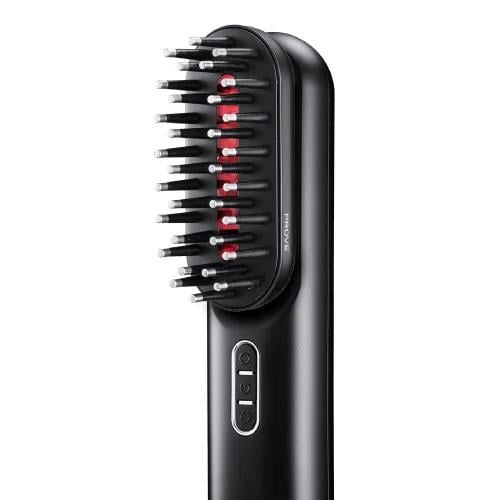
MYTREX PROVE MT-PV22B — the high-output one

MYTREX PROVE MT-PV22B — 48,805 JPY (~$307)
This is the most serious piece of hardware on the list and the one with the most specific spec sheet. It runs two separate pulse modes: a “Skin Lift” pulse that the manufacturer rates at up to 520V, delivered through a soft brush head carrying 32 electrode needles, and a “Deep EMS” pulse aimed at the muscle layer. It ships with three swappable attachments — SCALP & FACE, FACE, and BODY — and the mode switches automatically depending on which one you click on. Five intensity levels.
The scalp attachment is the genuinely unusual part. Very few at-home EMS devices treat the scalp as part of the same continuous sheet of tissue as the face, and if you’re the kind of person who already gets scalp massages, this is the one that will make sense to you.
The caveat: it’s ¥48,805, and it was released in October 2022 — this is an established flagship rather than a new one, so you’re paying near-flagship money for a four-year-old model. The 520V figure also sounds alarming out of context (it’s a very short, very low-current pulse, which is how these work), but it does mean the sensation at higher levels is strong. Start at level 1 and stay there for a while.
Brighte ELEKI LIFT BRT-FL170 — the do-everything mid-ranger

Brighte ELEKI LIFT BRT-FL170 — 23,535 JPY (~$148)
Brighte’s pitch is quantity: 15 listed functions in one handset, combining EMS, RF at up to 3MHz, and both red and blue LEDs. The EMS is branded “Triple Wave,” meaning three waveforms layered together, which the brand says makes the sensation less sharp. The listing splits usage into a light daily mode and a heavier RF “HEAT” mode it recommends limiting to 2–3 times a week — which is a refreshingly specific instruction, and one I’d follow rather than treat as a suggestion.
At roughly half the PROVE’s price with a broader function list, it’s the obvious pick if you want to try RF and EMS and LED without buying three things.
The caveat: the listing states plainly that no USB power adapter is included — you supply your own 5V 1A plug. Minor, but annoying if you unbox it expecting to charge immediately. And 15 functions on a small handset means a Japanese-language manual you’ll actually need to translate, not skim.
For Dryness and Dullness: Warmth Plus Current
A-Stage Re:De Suhada FM01A — the mascara-sized stick

A-Stage Re:De Suhada FM01A-WT — 24,552 JPY (~$154) (also in Hygge Gray and Space Gray)
Released July 2025, so this is the newest thing here. It’s a 14.7cm stick weighing 50g — the listing compares it to a mascara, which is accurate — combining EMS, red and blue LEDs, gentle heat, and vibration across three modes. There’s a dedicated charging stand, a travel pouch, and about 30 minutes of runtime per two-hour charge.
The detail I like most is material honesty: the electrodes are surgical stainless steel (316L), chosen specifically to reduce metal-allergy reactions. That’s a real consideration for anyone who reacts to costume jewelry, and most brands in this price band don’t bother to specify the alloy. The listing also frames its heat function around dryness and dullness rather than lifting, which is a more modest and more believable pitch.
The caveat: 30 minutes of runtime is short if you’re treating face and neck, and the small head that makes it travel-friendly also makes covering a whole face slower than a wide handset would. It’s a top-up device, not a full-session one.
Cattre NiCHOICE NBT-218 — the value multi-function pick

Cattre NiCHOICE NBT-218 — 17,763 JPY (~$112)
Cattre’s NiCHOICE line is the quiet value brand in this catalog, and the NBT-218 is its four-technology model: EMS, RF, LED, and vibration, each with three levels, usable independently or stacked. There’s a 30-minute timer, an LCD panel so you can actually see which program you’re in, a charging stand, and about 90 minutes of use per charge. At ¥17,763 it undercuts the Brighte by a third while covering most of the same ground.
The caveat: same as the Brighte — no AC adapter in the box, you supply a USB 5V 1A plug. The LCD is Japanese-labeled, and the body is ABS resin with a plated head rather than anything premium-feeling. If build quality in the hand matters to you, this is where the money went missing.
For the Eye Area and Nasolabial Folds
The skin around the eyes is thinner and more reactive than the rest of the face, so this sub-category exists for a reason — and both devices here handle it the same way, by putting a gel pad between the electrode and your skin instead of running metal directly against it.
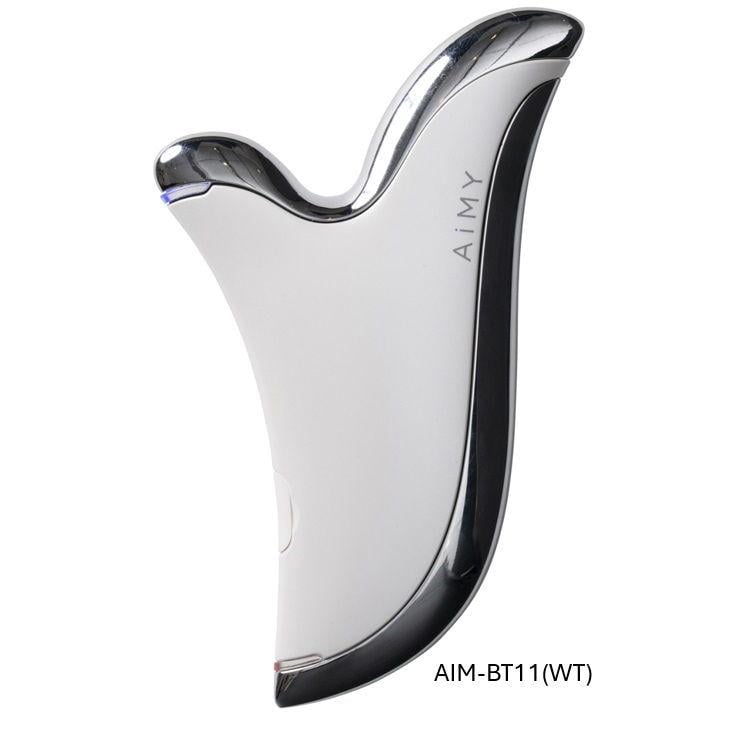
AiMY BEAUTY EYE AIM-BT122 — the cheapest way in

AiMY BEAUTY EYE AIM-BT122 — 12,276 JPY (~$77)
At ¥12,276 this is the least expensive device on the list, and it’s aimed squarely at the eye area and nasolabial folds using red LED plus EMS in about 10 minutes a day, hands-free while you do something else. It’s small enough to travel with and comes with a case.
The caveat, and it’s an important one: the listing is emphatic that the electrodes must never touch skin directly — always use it over a gel pad or eye mask. It also warns that gel pads hold moisture and can discolor within 2–3 days if they’re left in contact with metal, in which case you replace the pad and wipe the device. So budget for consumable pads, and treat that instruction as a hard rule, not a tip.
NIPLUX EMS EYE LIFT NP-EEL25 — the hands-free pads

NIPLUX EMS EYE LIFT NP-EEL25 — 24,552 JPY (~$154)
These are two tiny C-shaped units, 17g each, that stick to the sides of your eyes via gel pads and run a low-frequency EMS cycle with automatic shut-off at about 5 minutes. NIPLUX names the four muscles it targets — frontalis, temporalis, orbicularis oculi, zygomaticus minor — which is more anatomical specificity than most brands offer, and the battery is rated for roughly 72 five-minute sessions per charge.
There’s also a genuinely useful usage note buried in the listing: lightly dampening the skin or applying gel first makes the current conduct more evenly, and dry skin is what causes that sharp tingling people complain about. Worth knowing before your first try.
The caveat: ¥24,552 is a lot for a device that does one thing on one small area for five minutes, and at twice the AiMY’s price the value case is thin unless the hands-free form factor is specifically what you want. No AC adapter included here either.
For One Very Specific Spot: The Nose
NIPLUX QNose NP-QN25-BK — the nose clip

NIPLUX QNose NP-QN25-BK — 21,824 JPY (~$137)
This is the strangest and most Japanese product on the list: a clip that sits on your nose and runs low-frequency EMS through carbon pads — no gel or replacement sheets needed, which is a real practical advantage over the eye devices above. It adds blue LED, is rated IPX4 splash-resistant so you can wear it with a face pack, and auto-shuts-off at about 10 minutes specifically to stop people overdoing it.
The caveat, stated plainly: NIPLUX’s listing describes the clip as shaping the nose by pressing the cartilage from both sides. I’d treat that part with real skepticism — nasal cartilage is structural, and the idea that external clipping reshapes it isn’t something I’d take on a product page’s word. If you’re buying this, buy it for the EMS-and-LED skin care around the nose and the ritual of it, and set your expectations for permanent contour change at roughly zero. NIPLUX’s parent company is licensed as a second-class medical device manufacturer in Japan, which speaks to manufacturing standards, not to that specific claim.
If You Want the Sheet-Mask Ritual With Current Attached
JANCOSME MILINDA Startup Set — mask plus EMS regulator

JANCOSME MILINDA Startup Set — 22,097 JPY (~$139)
The odd one out, and the reason I wanted it on the list. MILINDA is a wearable system: you lay a serum-soaked sheet mask over your face and neckline, clip a small “REGULATOR” unit onto the mask’s connector, open the app, and run a 30-minute session that combines EMS with iontophoresis. The startup set includes the regulator plus five masks. The masks themselves are formulated for iontophoresis and are free of mineral oil, parabens, alcohol, synthetic colorants, synthetic fragrance, and silicones — a genuinely thoughtful list if you’re fragrance-sensitive.
JANCOSME recommends once a week, 30 minutes, and the listing includes the usual sheet-mask hygiene rules: use immediately after opening, never reuse a mask, don’t sleep in it, don’t use it on skin that’s still hot or red after sun exposure.
The caveat: it’s a consumables business model. Five masks at ¥22,097 for the set means you’ll be rebuying masks to keep using the device, and the mask supply chain runs through Japan. The listing’s “over 100 times” absorption figure for iontophoresis versus manual application is a manufacturer claim, and one I’d file under marketing rather than measurement. It’s also app-dependent, which is a durability question over a five-year horizon.
Comparison Table
| Device | Best for | Core tech | Price (as of Aug 27, 2026) |
|---|---|---|---|
| MYTREX PROVE MT-PV22B | Whole face, body, scalp | EMS + skin-lift pulse, 32 electrodes, 3 heads | 48,805 JPY (~$307) |
| Brighte ELEKI LIFT BRT-FL170 | Trying several technologies at once | EMS + 3MHz RF + red/blue LED | 23,535 JPY (~$148) |
| A-Stage Re:De Suhada FM01A | Dryness, dullness, travel | EMS + LED + heat + vibration, 316L steel | 24,552 JPY (~$154) |
| Cattre NiCHOICE NBT-218 | Multi-function on a budget | EMS + RF + LED + vibration | 17,763 JPY (~$112) |
| AiMY BEAUTY EYE AIM-BT122 | Eyes, nasolabial folds, low spend | EMS + red LED, gel pads | 12,276 JPY (~$77) |
| NIPLUX EMS EYE LIFT NP-EEL25 | Hands-free eye sessions | Low-frequency EMS, C-shaped gel pads | 24,552 JPY (~$154) |
| NIPLUX QNose NP-QN25-BK | The nose area specifically | EMS carbon pads + blue LED, IPX4 | 21,824 JPY (~$137) |
| JANCOSME MILINDA Startup Set | Weekly mask ritual with current | EMS + iontophoresis, app-controlled, 5 masks | 22,097 JPY (~$139) |
USD figures are approximate conversions from the JPY listing at roughly ¥159 to the dollar (the rate in late August 2026) and exclude shipping and any customs charges. Prices and stock move — check the live listing before buying.
Who Should Skip EMS Devices Entirely
This is the part I’d want a friend to read before the product list, honestly. Across manufacturers, the consistently repeated contraindications for microcurrent and EMS devices are:
- A pacemaker, defibrillator, cochlear implant, or any implanted electronic device. This is the big one — the current can interfere with the implant’s signal.
- Pregnancy. Not because harm is established, but because safety hasn’t been studied enough to say otherwise.
- Epilepsy or a history of seizures.
- Active cancer, or a heart condition.
- Broken, irritated, sunburned, or infected skin, and the immediate eye area unless the device is specifically built for it.
If any of those describe you, or you’re simply not sure, this is a genuine “ask your doctor or dermatologist first” situation rather than a formality. And if you have rosacea, very reactive skin, or metal sensitivities, start at the lowest setting on a small area and give it a day before committing to a routine.
How Do You Actually Fit One of These Into a Routine?
Here’s the practical order, which the listings mostly assume you already know:
- Cleanse first. EMS on top of makeup or sunscreen is a waste of a session, and the current conducts poorly through it.
- Add slip. Almost every one of these devices works better with a conductive gel, a hydrating essence, or at minimum damp skin. NIPLUX says this outright: dry skin is what makes EMS feel sharp and prickly.
- Run the session at the recommended duration, not longer. Several of these have auto-shutoff timers precisely because “more” is the failure mode people fall into.
- Wipe the head down afterward — most listings recommend an alcohol wipe on the metal contact surface, and gel left to dry on an electrode is how these devices die.
- Follow with your usual serum and moisturizer, and sunscreen if it’s daytime. One note: some Japanese LED and plasma devices ask you to avoid makeup or sunscreen immediately after a session, so check your own manual — it’s part of why a lot of people run these at night.
Two to three sessions a week is the frequency most of these boxes land on. There’s no medal for daily.
FAQ
How do I patch test a device rather than a product?
With a device, “patch testing” means starting at the lowest intensity, on a small area away from your face — the inside of the forearm works well — for a shorter session than you eventually plan to run. Wait a full day and look for lingering redness, itching, or irritation before using it on your face. If a device uses gel pads or a conductive gel, patch test that gel too, since it’s a leave-on cosmetic in its own right.
Will a Japanese EMS device work on my voltage at home?
Most of the devices here are USB-rechargeable, which sidesteps the problem entirely — you plug the supplied cable into your own 5V 1A adapter. Several listings, including the Brighte ELEKI LIFT and the Cattre NBT-218, specifically note that no AC adapter is included, so you’ll be using a local plug anyway. Devices with a fixed AC adapter are where you need to check the Japanese 100V rating against your country’s supply.
What about shipping and customs from Japan?
Discovery Japan Mall ships internationally from Japan, so add shipping time and possible import duties or fees on top of the listed yen price, depending on where you live. Manuals and on-device labeling are usually Japanese-only, so it’s worth finding an English demo video for your exact model number before the first session — especially for multi-mode devices where the buttons aren’t self-explanatory.
Is EMS safe around the eyes?
Only with a device designed for it, and only over a gel pad. Both eye devices here — the AiMY BEAUTY EYE and the NIPLUX EMS EYE LIFT — put a gel barrier between the electrode and the skin, and AiMY’s listing states explicitly that the electrodes must never contact skin directly. Don’t improvise by using a general face handset on your eyelids, and skip it entirely if you have an eye condition without checking with a doctor first.
How long before I’d notice anything, and is it permanent?
Manufacturers generally describe these as cumulative cosmetic effects with regular use, and several footnote “lift” as meaning the upward direction you move the device rather than a lasting change. Treat any visible difference as temporary and dependent on continuing to use the device, the way you’d treat the effect of a good massage rather than a procedure. If you want something permanent, that’s a conversation for a dermatologist, not a shopping decision.
The Takeaway
Buy for the area you actually care about. If it’s the whole face and you want one device to last, the MYTREX PROVE is the serious option and the Brighte ELEKI LIFT is the sensible-money version of the same idea. If it’s tired-looking eyes, the AiMY BEAUTY EYE at ¥12,276 is the cheapest honest entry point in this entire catalog. If it’s dryness and you travel, the Re:De Suhada stick. And if what you really want is a weekly ritual rather than a gadget, MILINDA turns a sheet mask into a 30-minute event — just go in knowing you’re buying into a mask subscription.
What none of them are is a treatment. Read the asterisks, start on level one, and check the contraindication list above before you check out. If you’d rather start with something with no current at all, our ReFa facial roller guide covers the manual end of the same shelf.
コメント