※本ページはプロモーションが含まれます
Disclosure: This post contains affiliate links. If you buy through them, we may earn a commission at no additional cost to you. Learn more.
If your For You Page has been full of people vacuuming their nose or scrubbing their chin with a buzzing silicone brush, you’ve run into the two biggest categories of Japanese facial cleansing devices: pore vacuums (suction tools that pull sebum and blackheads out of pores) and cleansing brushes (bristle or silicone heads that physically loosen dirt and dead skin during your normal wash). Neither is a miracle, and dermatologists have real concerns about the suction category specifically — but used correctly, both can genuinely make your regular cleanser work harder. Below is a real lineup of five in-stock Japanese devices, what each one actually does, honest pricing as of August 2026, and the safety rules worth following before you turn anything on near your face.
- Pore Vacuum or Cleansing Brush — Which Do You Actually Want?
- NIPLUX Multi Skin Cleaner NP-MSC25BK — the do-it-all pore cleanser
- Panasonic Pore Suction Spot Clear EH-SC10-E — the simple, budget suction option
- Panasonic Estegeine Pore Suction Spot Clear Rise EH2592PP-P — stronger suction, waterproof
- Panasonic Facial Cleansing Brush Firm Type EH-2S03 — the everyday sonic brush
- GESKE Facial Cleansing Brush (Hello Kitty) HK000016ST01 — the gentle, portable pick
- How to Use a Pore Vacuum Without Overdoing It
- Comparison Table
- FAQ
- The Takeaway
- Related Articles
Pore Vacuum or Cleansing Brush — Which Do You Actually Want?
These are not interchangeable tools, even though they get lumped together in “facial device” roundups.
Pore vacuums use a small motor to create suction at the tip, which is placed directly over a pore for a second or two to pull out sebum and loosened debris. They work best on skin that’s already been cleansed and gently warmed (steam, a warm washcloth, or a warm-water mode built into the device), because dry, tight pores don’t release much of anything. They’re a once- or twice-a-week spot treatment, not a daily step.
Cleansing brushes replace or supplement your hands during the actual washing step — you put your regular cleanser on the brush head and use it like a slightly more mechanical version of washing your face, then rinse. They’re gentler by design and made for regular, even daily, use.
If you already have a solid double-cleansing routine and are mainly bothered by visible blackheads around the nose, a pore vacuum is the more targeted (and more caution-requiring) buy. If you just want your everyday cleanser to feel like it’s doing more, a cleansing brush is the lower-risk starting point.
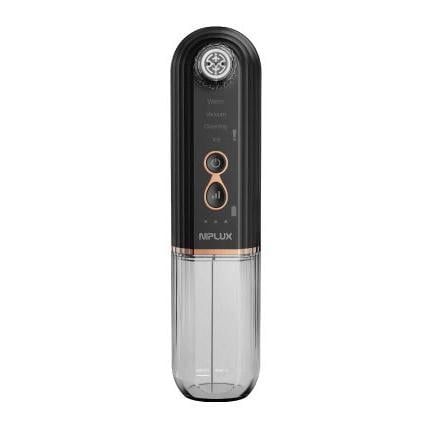
NIPLUX Multi Skin Cleaner NP-MSC25BK — the do-it-all pore cleanser

This is the most elaborate device in the lineup and the one worth leading with. Instead of a plain suction tip, NIPLUX built a multi-mode system: a Warm mode (warm water plus red LED) to soften pores before suction, a Vacuum mode with two interchangeable heads (a round head for cheeks/forehead, an oval head for around the nose), a Cleaning mode that runs water through the head to rinse away loosened debris, and an Ice mode (cold water plus blue LED) meant to close pores back up afterward. It’s rechargeable, takes about 3.5 hours to charge, and switches modes with a single button. Per the Discovery Japan Mall listing, it’s priced at about 24,552 JPY (roughly $155 USD, August 2026).
Caveat: this is the priciest device here by a wide margin, it needs an AC adapter that isn’t included, and NIPLUX’s own instructions warn not to hold the vacuum head on the same spot for more than 5 seconds or use it repeatedly on one area — skipping that advice is exactly how suction tools cause the redness and broken capillaries dermatologists warn about.
Panasonic Pore Suction Spot Clear EH-SC10-E — the simple, budget suction option

If the NIPLUX is more device than you want, this is Panasonic’s stripped-down version of the same idea: a single suction tip, no LED or multi-mode system, just on/off pore suction. It’s the cheapest device in this roundup and a reasonable way to try the category before committing to something more expensive. Per the listing, it runs about 4,786 JPY (roughly $30 USD, August 2026).
Caveat: without a warming step built in, you’ll need to do your own prep (a warm washcloth or right after a warm shower) for the suction to actually pull anything loose — used cold and dry, it’s more likely to just tug at the skin.
Panasonic Estegeine Pore Suction Spot Clear Rise EH2592PP-P — stronger suction, waterproof

A step up from the EH-SC10-E in the same Panasonic suction family, this one specifies its suction pressure (about 40kPa) and has a slim cup shaped for small nostril areas, plus a waterproof build that’s rated for bath use. Per the product listing, it’s priced at about 5,717 JPY (roughly $36 USD, August 2026).
Caveat: a stated suction pressure is a feature, not a safety guarantee — stronger suction means it’s easier to overdo it on delicate or thin-skinned areas, so this is the one to be most conservative with in terms of time-per-spot and frequency.
Panasonic Facial Cleansing Brush Firm Type EH-2S03 — the everyday sonic brush

This is the cleansing-brush half of the lineup: a compact sonic brush meant to pair with your normal cleanser during your actual wash step, rather than a separate suction treatment. Panasonic markets it as the “Firm Type” for people who want a stronger cleaning sensation than their softer counterpart, and estimates the brush head lasts about a year with weekly use or about three months with daily use. Per the listing, it’s priced at about 3,774 JPY (roughly $24 USD, August 2026).
Caveat: “firm” bristles are, by design, more textured against skin — if you have reactive or easily-irritated skin, this is a device to introduce gradually (a few times a week, not daily out of the gate) rather than swapping in for hand-washing every night immediately.
GESKE Facial Cleansing Brush (Hello Kitty) HK000016ST01 — the gentle, portable pick

GESKE’s take uses soft silicone bristles instead of nylon, marketed as gentle enough for daily use, with a thin head shape designed to reach around the nostrils. It’s palm-sized (50g), fully waterproof for shower use, and — notably for a device this size — pairs with a companion app for guided routines. This particular version is a Hello Kitty collaboration, which makes it a fun gift pick as much as a serious skincare tool. Per the listing, it’s priced at about 2,871 JPY (roughly $18 USD, August 2026).
Caveat: silicone bristles are gentler than nylon ones, which also means less physical exfoliation — if you specifically want a stronger mechanical scrub, the Panasonic EH-2S03 above will do more; this one is built around gentleness first.
How to Use a Pore Vacuum Without Overdoing It
Because suction devices come up in dermatology coverage more than cleansing brushes do, they deserve their own ground rules. Board-certified dermatologists quoted by NBC Select warn that high suction settings held too long or used too often can cause micro-tears, redness, bruising, and even broken capillaries — and that people with rosacea, very sensitive skin, or existing broken capillaries should be especially cautious. Reviva Labs makes a similar point: moderation is the key variable, not the device itself. In practice that means: use on clean, slightly warmed skin (never bare, unwashed skin); keep each pass to a second or two per spot rather than holding it in place; start on the lowest suction setting your device offers; skip it entirely over active breakouts, sunburn, or freshly exfoliated skin; and treat it as a once- or twice-weekly spot step, not a daily habit.
Comparison Table
| Product | Type | Key Feature | Approx. Price (Aug 2026) |
|---|---|---|---|
| NIPLUX Multi Skin Cleaner | Pore vacuum | Warm/vacuum/clean/cold LED modes | 24,552 JPY (~$155) |
| Panasonic EH-SC10-E | Pore vacuum | Simple single-mode suction | 4,786 JPY (~$30) |
| Panasonic Estegeine EH2592PP-P | Pore vacuum | ~40kPa suction, waterproof | 5,717 JPY (~$36) |
| Panasonic EH-2S03 | Cleansing brush | Firm nylon bristles, sonic | 3,774 JPY (~$24) |
| GESKE Hello Kitty Brush | Cleansing brush | Soft silicone, app-guided | 2,871 JPY (~$18) |
Prices are approximate USD conversions from JPY listings at August 2026 exchange rates and exclude shipping/customs; check the live listing for the current price before buying.
If rollers and microcurrent are more your speed than pores and suction, our ReFa facial roller guide covers that side of the Japanese beauty-device world.
FAQ
Should I patch test a facial cleansing device?
Since these devices contact skin directly rather than being a leave-on product, “patch testing” mostly means starting gentle: try a cleansing brush on the lowest setting for a shorter session than you eventually plan to use, and try a pore vacuum on the lowest suction setting on one small area first. Watch for excess redness, stinging, or irritation over the following day before making it a regular step.
How do I make sure I’m buying an authentic device and not a knockoff?
Buy from a listing that’s explicitly sourced from Japan, like Discovery Japan Mall, rather than an unverified third-party marketplace seller, and check that branding, model numbers, and packaging match the manufacturer’s official site. This matters more for suction devices, since a poorly made knockoff motor is more likely to run at unpredictable, unsafe suction levels.
What about shipping and customs since these ship from Japan?
Discovery Japan Mall ships internationally from Japan, so factor in shipping time and possible customs duties or import fees depending on your country — these aren’t included in the listed JPY price. Instruction manuals and packaging are typically in Japanese, so it’s worth looking up an English demo video for the specific model before your first use.
Where does a cleansing device fit in a routine, and can I use it with actives like retinol or exfoliating acids?
Cleansing brushes replace the physical washing step, so they go where hand-washing normally would, at the very start of your routine. Pore vacuums come after cleansing, on skin that’s been warmed but not yet moisturized. Skip either device on nights you’re already using a strong acid or retinol, or on skin that’s actively peeling or irritated — adding mechanical action or suction on top of an active is a common way people end up over-exfoliated.
Is a pore vacuum safe for sensitive skin or rosacea?
Dermatologists specifically flag rosacea, very reactive skin, and existing broken capillaries as reasons to be extra cautious with suction devices, since the same mechanism that pulls out sebum can also stress fragile capillaries. If that describes your skin, a cleansing brush on its gentlest setting (or skipping devices altogether in favor of your hands) is the lower-risk choice, and it’s worth checking with a dermatologist before adding any suction device to your routine.
The Takeaway
Japanese brands split this category cleanly into two tools with two different jobs: pore vacuums for a targeted, occasional deep-clean of visible pores, and cleansing brushes for a gentler, more frequent upgrade to your everyday wash. Start with the NIPLUX Multi Skin Cleaner if you want the full warm-suction-cool system in one device, the plain Panasonic EH-SC10-E if you just want to try suction cheaply, and either Panasonic sonic brush for a firmer scrub or the GESKE for a softer, app-guided one. Whichever you pick, moderation and a genuinely warmed, clean face before you turn it on will do more for your results than suction strength or bristle stiffness ever will.
コメント