
※本ページはプロモーションが含まれます
Disclosure: This post contains affiliate links. If you buy through them, we may earn a commission at no additional cost to you. Learn more.
If you’ve ever picked up a Japanese sunscreen and stared at a row of plus signs, here’s the short version: SPF is the UVB number, PA+ through PA++++ is the UVA rating, and the star marks are about water resistance. Once you can read those three things, the rest of the decision — milk or essence or gel or stick, tone-up or not, sebum-control or not — is basically about texture preference and climate, not about which bottle is “stronger.”
This is a label-decoder rather than a shopping list, and I want to be straight with you about why. The shop I normally link products from, Discovery Japan Mall, stocks Japanese beauty devices and Kumano brushes — I went through its whole catalog and it doesn’t carry sunscreen at all. So there are no affiliate product links in this piece for the sunscreens themselves. What I can do is explain the label system properly, so that whichever retailer you end up ordering from, you know exactly what you’re buying.
The Three Numbers That Actually Matter
Japanese UV labels are more informative than US ones, and the reason is that they carry a separate, graded UVA rating instead of a single yes/no “broad spectrum” tick.
SPF: the UVB number (and why it stops at 50+)
SPF is measured against UVB, the wavelength band responsible for sunburn. It’s a ratio measured on human skin in a lab: how much longer it takes for the test skin to redden with the product on versus without it.
The thing that trips people up is that Japanese bottles never say SPF 60 or SPF 100. Under the Japan Cosmetic Industry Association’s (JCIA) labeling standard, anything that tests above 50 gets printed as SPF50+ rather than the raw number. So an SPF50+ product might have tested at 55 or at 90 — you can’t tell from the box, and the label deliberately doesn’t let you. Practically, that means comparing two SPF50+ Japanese sunscreens on “strength” is a dead end. Compare them on the PA rating, water resistance, and how they feel instead.
PA: the UVA rating, in plus signs
PA is the part US shoppers usually haven’t seen before. It grades UVA protection on a four-step scale using the PPD (Persistent Pigment Darkening) method — essentially, how much longer UVA-driven tanning takes with the product on. The JCIA introduced the system in the mid-1990s and expanded it from three grades to four in 2013, when it adopted the ISO 24442 UVA test method.
| Label | UVA-PF (PPD) range | Rough plain-English read |
|---|---|---|
| PA+ | 2 to under 4 | Minimal UVA rating |
| PA++ | 4 to under 8 | Moderate |
| PA+++ | 8 to under 16 | High |
| PA++++ | 16 or above | Highest grade currently labelable |
Two useful notes. First, PA++++ is a floor, not a ceiling — like SPF50+, it covers everything at 16 and above, so two PA++++ products aren’t necessarily equivalent. Second, a high SPF does not automatically mean a high PA. You will find SPF50+ / PA+++ products sitting on the shelf next to SPF50+ / PA++++ ones, and if UVA rating is what you care about, that difference is the one to read.
The water-resistance marks
Since December 2022, Japanese UV products have used a JCIA voluntary standard for water-resistance claims based on the ISO immersion test. In practice you’ll see one or two star marks alongside wording like 耐水性 (“water resistant”) or 超耐水性 (“super water resistant”), corresponding to the 40-minute and 80-minute immersion tests. It’s the same two-tier structure as the US FDA’s 40/80-minute claims, just marked differently on the bottle.
If you’re commuting and sitting in an office, this is mostly irrelevant. If you swim, hike, or sweat through a humid August, it’s the single most useful mark on the package.
Texture Families: Milk, Essence, Gel, Cream, Stick
This is where Japanese sunscreen genuinely earns its reputation, and it’s also where most of the buying decision actually happens. The same SPF50+ / PA++++ spec ships in five or six completely different feels.
Milk (ミルク). A thin, fluid lotion. Spreads evenly, leaves a light film you can feel settling, and is generally the most reliable format for getting an even layer on the face and body. If you’re only going to learn one format, learn this one — it’s the default for a reason.
Essence (エッセンス). Watery, skincare-like, absorbs fast, minimal tack. This is the format that made Japanese sunscreen go viral overseas, because it feels like a serum rather than a sunscreen. The trade-off: because it’s so light, it’s very easy to under-apply and think you’ve done a full layer when you’ve done half of one.
Gel (ジェル). Cooling, slippery, spreads over a large area quickly, popular for body use in summer. Often the least “sunscreen-scented” of the bunch. Gels tend to feel like they disappear, which is pleasant but again makes it easy to skimp on quantity.
Cream (クリーム). The heaviest and most cushioned, usually the most moisturizing, and the one that holds a visible layer best. Better in winter or on dry skin; can feel like a lot in humidity, and it takes more effort to remove.
Stick (スティック). A solid balm in a twist-up tube. Its real job is top-ups over makeup, ears, hairline, and the tops of feet — places liquids are annoying to reapply. It’s a supplement to a liquid, not usually a replacement for one, because getting an even full-face layer out of a stick is difficult.
Powder. Worth knowing exists — a loose or pressed powder with UV filters, sold for reapplying over makeup. Treat it as a top-up convenience rather than your base layer.
The Two Japan-Specific Varieties: Tone-Up and Sebum-Control
“Tone-up” (トーンアップ)
Tone-up sunscreens are tinted UV products that add a cosmetic color-correcting cast rather than a foundation-style skin match. The most common tint is lavender, which is meant to counter yellow tones; you’ll also see blue, pink, mint, and neutral “white” versions. Manufacturers position them as a sunscreen-plus-makeup-base step so you can skip a separate primer.
Two honest caveats. Tone-up formulas frequently rely on titanium dioxide for the effect, so they can leave a visible cast — that’s the entire point on light skin, and a problem on deeper skin tones, where a lavender or white-cast product can read ashy. And “tone-up” is a cosmetic finish claim about how the product looks on skin, not a claim about changing your actual skin tone.
Sebum-control / shine-resistant
Formulas marketed on sebum resistance (皮脂 in the Japanese copy, usually alongside phrases about shine or 8-hour hold) typically include absorbing powders and film-formers meant to keep the layer from breaking up as your skin produces oil. Japanese summers are humid enough that this is a mainstream category rather than a niche one.
The catch is that the same powders that keep you matte can look and feel dry on dry or dehydrated skin, and can cling to flaky patches. If your skin isn’t oily, the standard version of a formula usually feels better than its sebum-control sibling.
How to Actually Pick One From Outside Japan
Here’s the order I’d go in:
- Pick the texture first, not the number. Almost every mainstream Japanese face sunscreen worth considering is SPF50+ already. The variable that decides whether you’ll actually wear it daily is how it feels.
- Then read the PA. If you specifically want the highest labeled UVA grade, look for PA++++ and don’t assume SPF50+ implies it.
- Check the star / water-resistance marks against your actual life. Super-water-resistant formulas are usually harder to remove; there’s no prize for buying more durability than you need.
- Match the format to the body part. A gel or milk for body, an essence or milk for face, a stick in the bag for top-ups.
- Check the size and the date. Japanese sunscreens are commonly 30–60 g for face formats and 80–90 g for body — smaller than the US norm, so budget accordingly if you’re applying properly. Japanese brands also reformulate frequently, and a listing photo may not match the current version.
- Know what you’re importing. Japanese sunscreens have access to UV filters — Tinosorb S and M, Uvinul A Plus, Uvinul T 150 — that the FDA has not approved for US sunscreens, which is a big part of why the textures are so much more elegant. The flip side is that a Japanese sunscreen bought overseas is not an FDA-approved OTC product in the US, packaging and instructions will be in Japanese, and you’re relying on the seller for freshness and authenticity. Buy from a retailer that sources directly from Japan, and check the batch/expiry markings when it arrives.
- Patch test before you commit to the face. Standard advice for any new product, and doubly worth it with a formula whose full ingredient list you can only read in Japanese. Dab a small amount on your inner forearm or behind the ear and give it 24 hours. If you have a diagnosed skin condition or known filter sensitivities, talk to your own doctor rather than to a blog.
“Do I Really Need to Reapply?”
This is the question I get most, so let’s answer it plainly. Every sunscreen label — Japanese, American, or otherwise — is based on a lab test using a specific, fairly generous application amount, and the number on the box describes that application, not a thinner one. Manufacturer directions on Japanese bottles consistently say to apply evenly, reapply after sweating, swimming, or towel drying, and to reapply periodically during extended time outdoors. That’s the guidance to follow, regardless of whether the bottle says PA+++ or PA++++.
The practical version of this: a stick or a UV powder in your bag exists precisely because reapplying a liquid over makeup at 2 p.m. is annoying. That’s the whole product category.
Taking It Off at the End of the Day
Japanese sunscreens — especially the super-water-resistant ones — are engineered to stay put, which means a splash of water and a foaming cleanser often isn’t enough. The standard Japanese answer is the first step of a double cleanse: a cleansing oil, balm, or milk to break the film down, then your usual foaming wash. Discovery Japan Mall doesn’t stock cleansing oils either, so I’m not linking one — any well-reviewed oil or balm cleanser will do the job.
If you’d rather put the effort into hardware than into a second product, the device route exists too.
Panasonic Dense Foam Esthetic EH-SC55-N — the optional gadget version
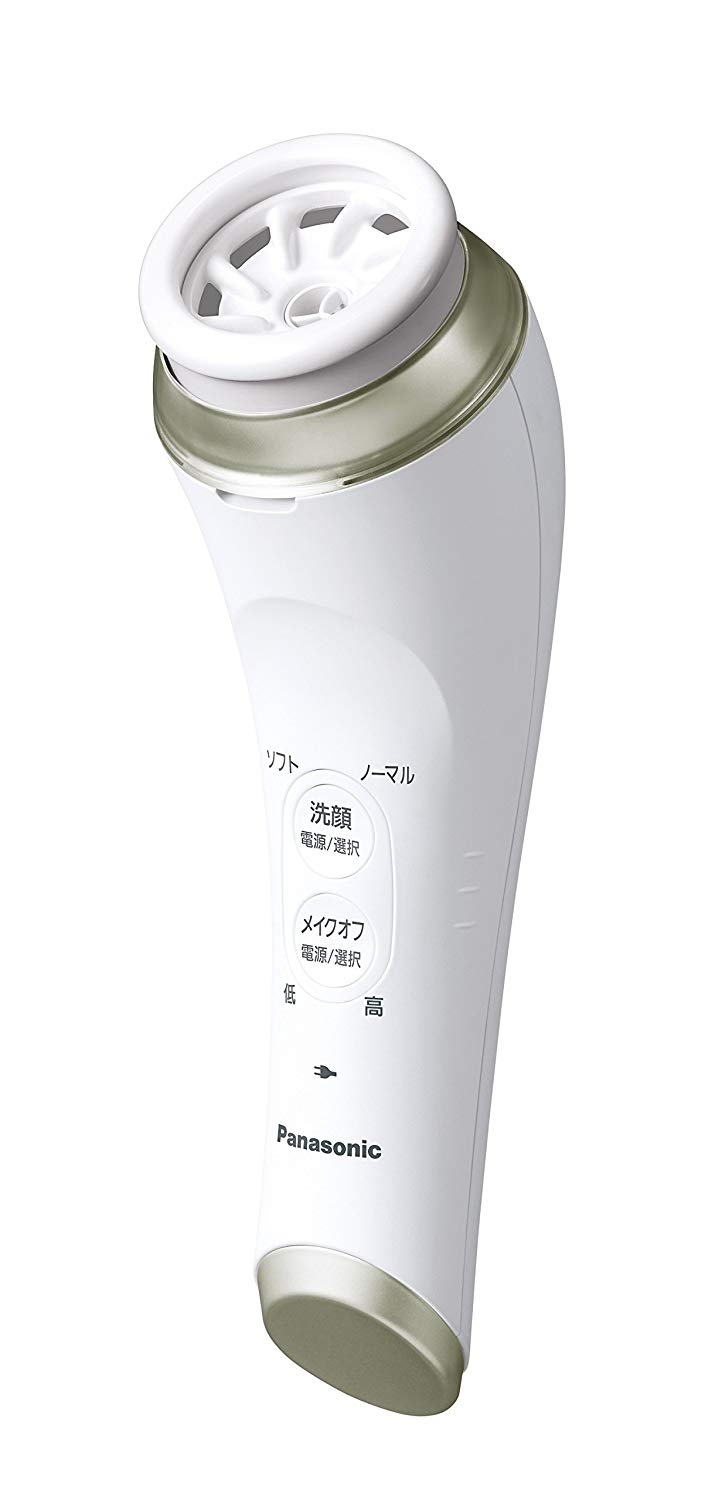
This is Panasonic’s 泡エステ (“foam esthetic”) unit, and per the listing it whips your cleanser into a dense foam in about five seconds, with a foam-brush head for washing and a warming “make-off” attachment for the makeup-removal step. The EH-SC55-N is listed at 24,893 JPY (roughly $159 USD) as of August 21, 2026.
The honest caveat is a big one: this is a $159 appliance that does a job a ¥1,000 bottle of cleansing oil already does. It’s a nice-to-have for people who already enjoy at-home facial gadgets, not a solution to a sunscreen-removal problem. It’s also a Japanese-domestic Panasonic unit, so check the voltage before plugging it in abroad, and the manual will be in Japanese. If you want a fuller look at that whole category, I compared the real options in Japanese Facial Cleansing Devices: Pore Vacuums vs. Brushes, including a $18 silicone brush that’s a far more sensible starting point.
Label Cheat Sheet
| What you see on the bottle | What it’s telling you | What to do with it |
|---|---|---|
| SPF50+ | Tested above SPF 50; exact value not disclosed | Treat as the ceiling; don’t chase a bigger number |
| PA+ / PA++ / PA+++ / PA++++ | UVA grade by PPD: 2–4 / 4–8 / 8–16 / 16+ | The number worth comparing between two SPF50+ products |
| 耐水性 ★ | Passed the 40-minute water immersion test | Fine for everyday sweat |
| 超耐水性 ★★ | Passed the 80-minute test | Swimming, sport, long outdoor days |
| トーンアップ | Tinted, color-correcting finish (often lavender) | Check the cast against your skin tone first |
| ミルク / エッセンス / ジェル / クリーム / スティック | Milk / essence / gel / cream / stick | The actual decision — pick by feel and body part |
Product price shown above is from the live Discovery Japan Mall listing as of August 21, 2026 and excludes international shipping and customs; check the listing for the current figure before ordering.
FAQ
What’s the difference between SPF and PA on a Japanese sunscreen?
SPF is a UVB measurement — how much longer test skin takes to redden with the product applied. PA is a separate UVA rating measured by the PPD (Persistent Pigment Darkening) method and expressed in plus signs from PA+ to PA++++. A Japanese label gives you both numbers, which is more granular than the single “broad spectrum” tick on a US label.
Is PA++++ always better than PA+++?
It’s a higher labeled grade, yes: PA+++ covers a UVA-PF of 8 to under 16, and PA++++ covers 16 and above. But PA++++ is an open-ended top band, so two PA++++ products aren’t necessarily equal to each other, and the difference in how a formula feels on your skin usually matters more for daily wear than one extra plus sign.
Why do Japanese sunscreens never go above SPF50+?
Because the Japan Cosmetic Industry Association’s labeling standard caps what can be printed. Anything that tests above SPF 50 is labeled SPF50+ rather than the measured number, so an SPF50+ bottle could have tested anywhere above 50. It means you can’t rank two SPF50+ products by their SPF, and should compare PA rating, water resistance, and texture instead.
Can I buy Japanese sunscreen in the US, and is it FDA approved?
You can order it from importers and Japanese retailers, but Japanese sunscreens are not FDA-approved OTC sunscreens in the US — they use UV filters such as Tinosorb S and M and Uvinul A Plus that the FDA has not approved for sunscreen use, which is a large part of why the textures are lighter. Practically that means Japanese-language packaging, no US drug facts panel, and reliance on your seller for freshness and authenticity, so buy from a retailer sourcing directly from Japan.
How do I take a water-resistant Japanese sunscreen off?
Water-resistant and super-water-resistant formulas are designed not to break up with water alone, so the usual Japanese approach is a double cleanse: a cleansing oil, balm, or milk first to dissolve the film, then a normal foaming cleanser. Give the first step enough time to actually emulsify rather than rushing it, and patch test any new cleansing oil the same way you would a new sunscreen.
The Takeaway
Japanese sunscreen labels look cryptic for about ten minutes and then become the clearest labels in the category. SPF50+ is a ceiling rather than a score, PA+ to PA++++ is the UVA number nobody else prints, and the star marks tell you how much water the layer will survive. Everything after that is texture: milk if you want reliability, essence if you want it to feel like skincare, gel for body, cream for dry skin and winter, stick for top-ups. Pick the one you’ll genuinely reapply, and the plus signs will take care of themselves.
コメント