※本ページはプロモーションが含まれます
Disclosure: This post contains affiliate links. If you buy through them, we may earn a commission at no additional cost to you. Learn more.
If your For You page has shown you someone sitting under a glowing red panel or wearing a light-up mask while scrolling their phone, you’ve seen LED light therapy — and Japan has been building dedicated at-home LED facial devices for over a decade. The short answer to “which one should I get”: the Exideal Mini is the cheapest, most portable entry point if you just want to try the category, the Libra mask is the one to get if you want hands-free use while doing something else, and the Ovo or Deux make sense if you want a more full-featured device with sensors or combined treatment functions. None of these replace a dermatologist or an in-clinic laser treatment, and — unlike a serum — you can’t just apply an LED device and forget about it; eye safety and consistent use matter more than with most skincare tools.
I’m going to walk through Exideal’s actual lineup, what each device is built for, real prices as of August 2026, and where the caveats are.
- What LED Light Therapy Actually Is
- Exideal Mini (EX-120) — the cheapest way to try it
- Exideal Sphera (EX-065) — the other entry-level option
- Exideal Libra (EX-HA03) — the hands-free mask
- Exideal Ovo (EX-HA01) — LED plus four more functions in one
- Exideal EX-280 (EX-B280) — the higher-tier predecessor
- Exideal Deux (EX-HA02) — the current flagship
- How to Actually Use One in a Routine
- Comparison Table
- FAQ
- The Takeaway
- Related Articles
What LED Light Therapy Actually Is
LED (light-emitting diode) facial devices work by exposing skin to specific wavelengths of visible light — most commonly red, blue, yellow, and near-infrared — without heat, UV, or the more intense energy of an in-clinic laser or IPL device. Dermatology sources describe red and near-infrared light as penetrating deeper into skin and being associated with collagen-related and inflammation-related effects, while blue light is more associated with surface-level use around blemish-prone skin. This is a genuinely different mechanism from a microcurrent roller (which uses a low electrical current) or an RF device (which uses heat) — it’s light exposure, not stimulation or heat.
The honest framing: LED phototherapy has real clinical research behind it and dermatologists and estheticians do use it in-office, but at-home consumer devices are lower-powered than professional units, and results described in the research (improved texture, subtler fine lines, calmer-looking skin) build gradually with repeat sessions rather than showing up after one use. It’s also worth knowing that eye safety is a real, documented concern with LED devices — at least one case of retinal irritation has been linked to improper eye protection with a blue-light mask, so any device that sits close to your eyes should be used exactly as instructed, with goggles or closed eyes as directed.
Exideal Mini (EX-120) — the cheapest way to try it

This is Exideal’s compact, travel-sized device — small enough to fit in a bag, built around 120 high-brightness LEDs across four wavelengths (red, blue, yellow, and near-infrared), with a mirrored panel design the brand says increases light exposure efficiency by directing more of the light back onto skin. It also includes a dedicated scalp-care mode, and per the listing runs on both Japanese and international voltage (100–240V), so it’s genuinely meant to travel. Per the Discovery Japan Mall listing, it’s priced at about 37,102 JPY (roughly $235 USD at August 2026 exchange rates) as of this writing.
Caveat: “portable” also means a smaller light-emitting surface than the larger panel-style devices in this lineup, so a full-face session takes longer since you’re covering less area at once.
Exideal Sphera (EX-065) — the other entry-level option

Priced almost identically to the Mini and sold in white, black, and pink, the Sphera is Exideal’s other entry-tier device. The Discovery Japan Mall listing for this one doesn’t include a detailed spec write-up beyond the product name and price, so beyond confirming it’s part of Exideal’s LED lineup at a similar price point to the Mini, it’s worth checking Exideal’s official product page for the full wavelength and LED-count breakdown before choosing between the two. Per the listings (white, black, pink), it runs about 37,884–38,191 JPY (roughly $240 USD, August 2026) depending on color.
Caveat: because the mall listing is sparse on this specific model’s specs, it’s the one in this lineup where I’d recommend double-checking exact features against the manufacturer’s own site before buying, rather than going on the marketplace description alone.
Exideal Libra (EX-HA03) — the hands-free mask

The Libra is Exideal’s mask-style device, designed to be worn hands-free while you do something else — the brand markets it explicitly as a “watch TV or scroll your phone while treating your skin” tool. It covers three zones (face, neck, and scalp) with red, yellow, and blue LED programs, each program timed to a 4-minute session, and comes with a USB charging cable, dedicated goggles, and nose pads in the box. At 172g and roughly 15.8 x 13.8 x 6.3cm, it’s a genuinely wearable shape rather than a handheld wand. Per the listing, it’s about 60,885 JPY (roughly $385 USD, August 2026).
Caveat: it doesn’t list near-infrared among its wavelengths (unlike the Mini, Ovo, and Deux below), and a mask that covers your eyes area needs the included goggles used correctly every time — don’t skip that step to save time.
Exideal Ovo (EX-HA01) — LED plus four more functions in one

Released in October 2020, the Ovo is a “5-in-1” handheld device: it pairs a 55-LED, four-wavelength program (blue for adolescent/T-zone skin, yellow for texture and firmness, red for mature/dry skin, near-infrared for firmness) with EMS (low-frequency muscle stimulation), ion-derivation cleansing, RF warming, and iontophoresis (to help serum ingredients absorb). That’s a meaningfully more complex device than the Mini or Sphera, with 8 total treatment patterns across its modes. Per the listing, it runs about 102,533 JPY (roughly $650 USD, August 2026).
Caveat: more functions means more to learn and more steps per session — if you just want a straightforward LED-only routine, this is more device (and more money) than you need; it’s built for people who specifically want the RF/EMS/ion-derivation add-ons alongside the light.
Exideal EX-280 (EX-B280) — the higher-tier predecessor
The EX-280 sits above the Ovo in price but the Discovery Japan Mall listing for it doesn’t include a spec description, so rather than guess at features I’ll flag it honestly: it’s part of Exideal’s higher tier alongside the newer Deux below, and if you’re considering it, check Exideal’s official site or ask the mall’s customer service for the current spec sheet before buying. Per the listing, it’s priced at about 142,000 JPY (roughly $900 USD, August 2026).
Caveat: at this price, with the Deux (below) available as Exideal’s newer flagship, it’s worth confirming exactly what you’re getting versus the newer model before spending here.
Exideal Deux (EX-HA02) — the current flagship

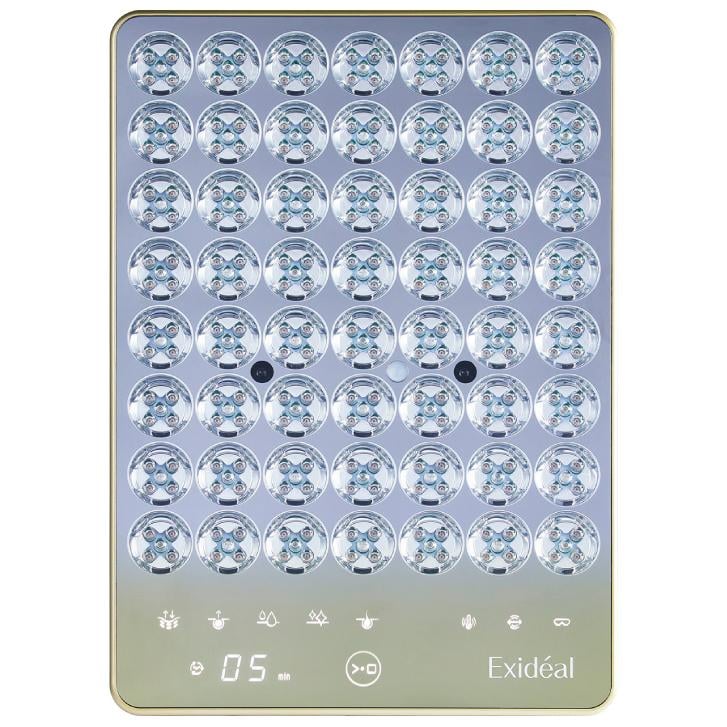
Released in February 2023, the Deux is Exideal’s newest and most feature-dense device: 280 high-brightness LEDs across red, yellow, blue, and near-infrared wavelengths, a larger panel sized for whole-body use (not just face), and — new for this model — a temperature sensor and distance sensor that the brand says adjust LED power and program based on your skin’s warmth and how close the panel is to your face. It also supports custom programs you build yourself rather than only using preset modes, and includes named programs for texture/firmness, adolescent skin, rough/dry skin, glowing skin, and scalp care. Per the listing, it’s about 151,566 JPY (roughly $960 USD, August 2026), making it the most expensive device in the lineup.
Caveat: this is a real investment for an at-home device, and the sensor/customization features are genuinely new additions rather than proven-over-years like the rest of the lineup — if you’ve never tried LED therapy before, starting with the Mini or Sphera first to see if you’ll actually use it consistently is the more sensible entry point.
How to Actually Use One in a Routine
LED devices are typically used on cleansed, dry or lightly moisturized skin (check your specific device’s instructions, since some brands advise against layering serums underneath during treatment), and are meant to come after cleansing but before your heavier moisturizer or oil step. Sessions in this lineup run anywhere from a stated 4 minutes (Libra) up to longer sessions for the panel-style devices — consistency across several sessions a week matters more than any single use, since the research behind LED phototherapy describes cumulative rather than instant effects. If your device includes goggles, use them; if it doesn’t specify eye protection, keep your eyes closed for the duration rather than looking toward the light.
Comparison Table
| Product | LEDs / Wavelengths | Format | Best For | Approx. Price (Aug 2026) |
|---|---|---|---|---|
| Exideal Mini | 120 LEDs, 4 wavelengths | Compact handheld, travel voltage | Trying LED therapy on a budget | 37,102 JPY (~$235) |
| Exideal Sphera | Not detailed in listing | Compact handheld, 3 colors | Budget option, verify specs first | 37,884–38,191 JPY (~$240) |
| Exideal Libra | Red/yellow/blue, 3-zone | Hands-free mask | Multitasking during treatment | 60,885 JPY (~$385) |
| Exideal Ovo | 55 LEDs, 4 wavelengths | Handheld, 5-in-1 (LED+EMS+RF+ion) | Wanting LED plus other functions | 102,533 JPY (~$650) |
| Exideal EX-280 | Not detailed in listing | Handheld, higher tier | Confirm specs before buying | 142,000 JPY (~$900) |
| Exideal Deux | 280 LEDs, 4 wavelengths | Large panel, sensors, custom programs | Full-body use, most features | 151,566 JPY (~$960) |
Prices are approximate USD conversions from JPY listings as of August 2026 exchange rates and exclude shipping/customs; check the live listing for the current price before buying. If you’d rather start with a microcurrent roller instead of an LED device, our ReFa facial roller guide covers that mechanism and lineup separately.
FAQ
How do I patch test an LED device before a full session?
Since these devices work through light exposure rather than a leave-on ingredient, there’s no traditional patch test. Instead, start with a short session (a couple of minutes) on a small area and watch for any unusual redness, heat sensitivity, or discomfort before doing a full-length treatment, and always follow the specific eye-protection instructions that came with your device.
Are LED facial devices safe for the eyes?
Eye safety is a genuine, documented concern with LED devices, particularly ones that emit blue light near the eye area — there have been reported cases of eye irritation linked to improperly used blue-light masks. Use any included goggles exactly as directed, keep your eyes closed if the device doesn’t include eye protection, and never look directly at an active LED panel.
How do I verify I’m buying an authentic Exideal device and not a knockoff?
Buying through a listing that’s explicitly sourced from Japan, like Discovery Japan Mall, and cross-checking the model name and photos against Exideal’s official site are reasonable ways to reduce the risk of a counterfeit, especially for a brand and category where gray-market resellers exist online.
What about shipping and customs since these ship from Japan?
Discovery Japan Mall ships internationally from Japan, so factor in international shipping time and possible customs duties or import fees depending on your country — these aren’t included in the listed JPY price. Instruction manuals and on-device text will likely be in Japanese, so it’s worth looking up an English unboxing or how-to video for visual guidance before your first use.
Can I use an LED device alongside retinol or exfoliating acids?
LED light itself doesn’t chemically interact with actives the way layering two leave-on products can, but skin that’s freshly exfoliated, purging, or irritated from a new retinol routine is generally more reactive to any additional stimulus. It’s reasonable to skip an LED session on nights your skin already feels sensitive, and if you have a diagnosed skin condition, are pregnant, or have a light-sensitivity condition, check with a dermatologist before adding any electronic light-emitting device to your routine.
The Takeaway
Exideal has built out a genuinely wide LED facial device lineup — from a $235 travel-sized starter to a $960 flagship with sensors and custom programs — and unlike some categories, this one has real dermatological research behind the underlying mechanism, even if at-home devices are gentler than clinic equipment. Start with the Mini if you want the lowest-cost way to see if LED therapy fits your routine, go Libra if hands-free matters most to you, and only step up to the Ovo, EX-280, or Deux once you know you’ll actually use the device consistently. Whichever you pick, respect the eye-safety instructions, buy from a Japan-sourced listing, and treat the glow as a gradual routine addition rather than an overnight fix.
コメント