※本ページはプロモーションが含まれます
Disclosure: This post contains affiliate links. If you buy through them, we may earn a commission at no additional cost to you. Learn more.
Here’s the answer up front: kassa (かっさ) is not a Japanese invention — it’s the Japanese reading of gua sha, the same two characters, borrowed from traditional Chinese medicine and reworked by the Japanese beauty market into a gentle, oil-slipped facial ritual. What Japan added is hardware. Where the original tool is a flat stone you push across skin, Japanese brands have spent the last few years building kassa-shaped devices that warm, vibrate, or run a current while you do it.
This is a how-and-whether guide rather than a shopping list. I’ll walk through what the technique actually is, the three tiers of tool you can buy, the routine step by step, and — the part most articles skip — who genuinely shouldn’t be doing this. Products appear where they illustrate a point, with real prices from Discovery Japan Mall as of August 27, 2026.
Kassa Is Gua Sha, Renamed — and Softened
The characters 刮痧 mean, roughly, “scraping sha.” In its traditional body form, gua sha is a firm scraping of the skin with a smooth-edged tool, and the sha part refers to the reddish petechiae it deliberately raises. That’s the version practiced in clinical TCM settings on the back and shoulders.
Facial kassa is not that. The version that became a beauty ritual in Japan and then went global on TikTok uses light-to-moderate pressure, always over a slip medium, and is specifically not meant to raise marks. If your face is coming away red and blotchy, you are doing the body technique on your face, and that’s a mistake — not a sign it’s working.
What Japanese brands emphasize in the beauty framing is contour work: slow strokes outward and upward along the jaw, cheekbone, and neck, plus the temporary de-puffing effect people notice most in the morning. That’s the honest scope of it. Facial kassa is a massage technique with a cosmetic, short-lived effect on how the face looks and feels. It doesn’t change facial structure, and any brand that implies otherwise is overselling.
The Three Tiers of Kassa Tool
The tool decision matters less than the technique, but it does change what the ritual feels like and how long it takes. There are broadly three tiers, and they’re not a ranking — the cheapest one is genuinely the right answer for a lot of people.
Tier 1: The plain stone or resin plate
The classic. A flat, smooth-edged plate — jade, rose quartz, bian stone, or moulded resin — with a curved side for the cheek, a notched side that straddles the jawline, and usually a pointed corner for small areas. It costs almost nothing, needs no charging, and travels anywhere.
Worth saying clearly: Discovery Japan Mall doesn’t stock plain kassa plates. Its beauty catalog is devices and brushes, so there’s no affiliate link I can honestly give you here. That’s fine — a stone plate is a commodity item you can pick up almost anywhere, and starting there before spending on a device is a perfectly sensible sequence.
The closest thing in the catalog to a no-electronics manual tool is a vibrating roller rather than a plate — the Cattre Brilliant V NBT-201 at 6,235 JPY (~$39) is a V-shaped twin-head roller with three vibration levels, running on two AAA batteries. It’s a different motion though — rolling pinches skin up between two heads, where kassa glides a single edge across it. If rolling is what you’re actually after, our ReFa facial roller guide covers that shelf properly.
Tier 2: The warming kassa device

This is the tier where Japanese brands added the thing a stone can’t do: sustained, controlled warmth. Warm skin takes the glide more comfortably and the whole session feels less like scraping and more like a treatment.
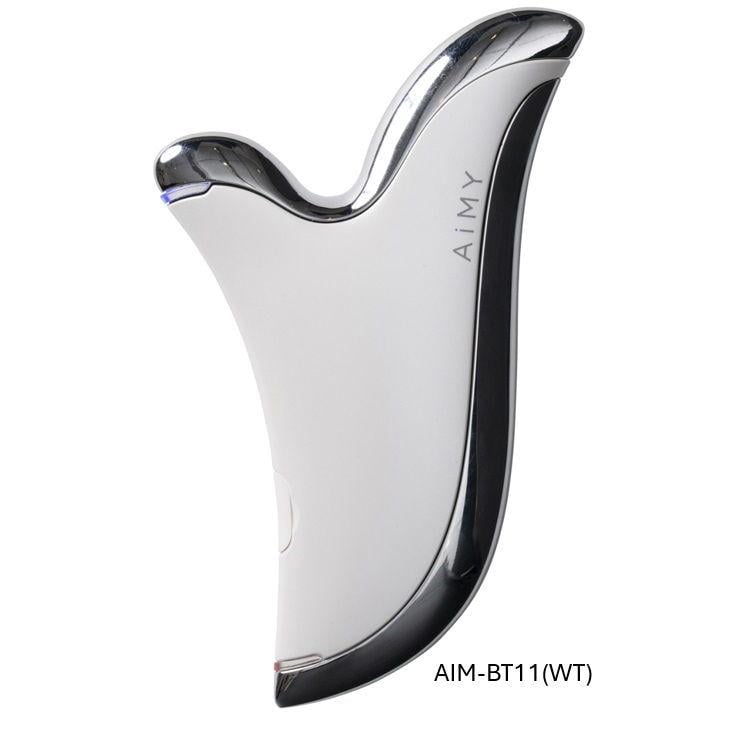
The AiMY KASSA HEARTUP AIM-BT11 at 19,592 JPY (~$123) is the accessible example — a gua-sha-shaped warming device, sold in white and a gray version at the same price. At the premium end sits the Panasonic Vitalift Gua Sha EH-SP86-K at 45,468 JPY (~$286), which is Panasonic’s dedicated kassa-shaped model in its Vitalift line.
The honest caveat for this tier: you’re paying somewhere between ¥19,000 and ¥45,000 for warmth and shape. A stone plate warmed under hot tap water for thirty seconds gets you a meaningful fraction of the same experience for a rounding error. Buy here because you want the ritual to be effortless and consistent, not because the warmth is doing something a stone fundamentally can’t. Both of these are also Japanese-market units with Japanese manuals, and neither listing carries a full English spec sheet — so if you need detailed documented settings before you buy, that’s a real friction point.
Tier 3: The kassa-shaped device that also runs a current

The top tier stops being a massage tool and becomes an electrical appliance shaped like one. Two clear examples:
The BRUNO Hot/Cold EMS Facial Lift BOE145-GR at 17,732 JPY (~$112) is described by BRUNO itself as a hot-and-cold gua sha device. It’s a crescent-shaped head with four functions: EMS at two intensity levels, a HOT mode and a COOL mode, an iontophoresis “booster” setting, and sonic vibration. Practical specs that actually matter: IPX5 on the metal head only (so not a bathtub device), 3-minute auto shut-off, roughly 25 three-minute sessions per three-hour charge, 183g, and a charging stand. BRUNO also sells a matching sheet mask separately (the Medicated Shiratama Whitening Sheet Mask, BOC005-7P) intended to be used with it.
The Panasonic Vitalift Kassa EH-SP85-K at 34,968 JPY (~$220) is the waterproof one, and that’s its whole argument — Panasonic explicitly builds it for use in the bath, which is where a lot of people’s kassa habit actually survives. It runs Panasonic’s “Dual Dynamic EMS,” gives about 8 minutes per session with roughly 5 sessions per full charge (3-hour charge time), weighs about 165g excluding the cap, and ships with a bottle of Panasonic’s own Water Clear gel — which matters, because these devices need a conductive slip medium, not just any facial oil.
The honest caveat for this tier: adding EMS changes the safety picture entirely. A stone plate has no contraindications beyond common sense; an EMS device has a real list, which I’ve put below. There’s also a running cost — conductive gel is a consumable, and BRUNO’s design nudges you toward its own sheet masks. And at ¥17,000–¥35,000 you’re now in the price band where you should ask whether you want a kassa tool or just a good EMS handset, which is a different product. If it’s the latter, I compared eight of them in Japanese EMS Facial Devices: 8 Picks by Skin Concern.
Quick tier comparison
| Tier | What it adds | Typical spend | Main trade-off |
|---|---|---|---|
| Stone or resin plate | Nothing electronic — just shape | Low, and not stocked here | Manual warmth, easy to use too hard |
| Warming device (AiMY, Panasonic EH-SP86-K) | Controlled, sustained heat | 19,592–45,468 JPY (~$123–$286) | Paying a lot for warmth a stone approximates |
| Kassa-shaped EMS device (BRUNO, Panasonic EH-SP85-K) | EMS, hot/cold, iontophoresis, waterproofing | 17,732–34,968 JPY (~$112–$220) | Contraindications, gel as a consumable |
USD figures are approximate conversions from the JPY listings at roughly ¥159 to the dollar in late August 2026, and exclude shipping and any customs charges. Prices and stock shift — check the live listing before buying.
The Routine, Step by Step
The technique is the same whichever tier you bought. Seven steps, and the first two are the ones people skip.
- Start clean. Kassa on top of makeup or sunscreen drags product into skin and gives you nothing. Cleanse first. If you’re using an EMS-equipped device, this is non-negotiable — current conducts badly through a sunscreen film.
- Lay down slip. A facial oil, a rich serum, or a slip-specific gel. For plain stone plates, any facial oil works. For EMS devices, use the conductive gel the manufacturer supplies or specifies — Panasonic ships Water Clear gel with the EH-SP85-K for exactly this reason. Insufficient slip is the single most common cause of irritation with this technique.
- Hold the tool almost flat. Roughly a 15-degree angle to the skin, not an edge-on scrape. The flatter the angle, the more the pressure spreads.
- Work outward and upward, in short strokes. Neck first (downward along the sides, toward the collarbone), then jaw from chin outward toward the ear, then cheek from the side of the nose outward, then along the brow. Three to five passes per section is plenty.
- Keep the pressure light to moderate. More on this below, because it’s where people go wrong.
- Stop at the session length the device tells you. BRUNO auto-stops at 3 minutes; Panasonic’s EH-SP85-K is built around ~8-minute sessions. Those numbers exist to stop you overdoing it. A full manual stone session is typically 5–10 minutes.
- Clean the tool, then finish your routine. Wipe the head down — most device listings suggest an alcohol-based wipe on the metal contact surface. Dried gel on an electrode is how these die. Then serum, moisturizer, and sunscreen if it’s morning.
Frequency: three to five times a week is the range most guidance lands on for cosmetic benefit. Daily is not better, and it’s the fastest route to irritating your own face.
How Much Pressure Is Too Much?
The rule I’d give a friend: enough to move the skin slightly, never enough to hurt, and never enough to leave marks that outlast the session. A little transient pink from increased circulation is normal and fades within minutes. Blotchy redness that’s still there twenty minutes later, or any small red dots, means you used too much pressure, too little slip, or too sharp an angle — and on the face, that’s a risk to fine capillaries rather than a badge of a job well done.
Three things cause almost every kassa mishap: pressing too hard, not enough oil, and holding the tool at too steep an angle. Fix those and the technique is a low-risk one.
Who Kassa Suits — and Who Should Skip It
It suits you if you like a slow, tactile step in your evening routine, you mainly care about morning puffiness and how your jaw and neck feel rather than expecting structural change, and you’re happy to be consistent for weeks rather than looking for an overnight result. It also suits people who want a J-beauty ritual with no consumables and no electronics — the stone-plate version costs almost nothing to maintain.
Be cautious, or skip it, if:
- Your skin is sensitive, rosacea-prone, or you already have visible broken capillaries. Dermatology commentary consistently flags this group, because the same friction that creates a flush can stress fragile vessels. If this is you and you still want to try it, use a lot of slip, the lightest possible pressure, and check with a dermatologist first.
- Your skin is sunburned, broken, actively inflamed, or you have an active breakout in the area. Dragging a tool over inflamed or open skin is straightforwardly a bad idea — work around it or wait.
- You’re on a strong active that night. Retinoids and exfoliating acids plus mechanical friction is a classic over-exfoliation combination. Separate them onto different evenings.
- You’re considering an EMS-equipped kassa device and you have a pacemaker, defibrillator, cochlear implant, or any other implanted electronic device; are pregnant; have epilepsy or a seizure history; or have an active cancer or heart condition. These are the contraindications manufacturers list consistently for EMS and microcurrent devices, and they’re the reason the tier-3 tools aren’t universally recommendable. If any apply, either stay in tier 1 or 2, or talk to your doctor first.
Everyone else: patch test the slip product you plan to use, start with fewer passes than you think you need, and give it a day before making it routine.
What to Check Before You Buy a Kassa Device
If you’ve decided a device is worth it over a plate, this is the checklist I’d run:
- Does it need a proprietary gel? Panasonic’s kassa units are built around a conductive gel and ship with one. Budget for refills.
- Is it actually waterproof, and how much? “Bath-safe” and “IPX5 on the head only” are very different claims — the BRUNO’s rating covers the metal head, not the whole body. The Panasonic EH-SP85-K is the one explicitly built for in-bath use.
- What’s the session length and does it auto-stop? Auto shut-off is a feature, not a limitation.
- Charge time versus sessions per charge. The EH-SP85-K’s roughly 5 sessions per 3-hour charge is a real planning constraint if two people share it.
- Power and voltage. Japanese-market devices with a fixed AC adapter are rated for Japan’s 100V supply — check that against yours. USB-rechargeable models sidestep the issue.
- Manual language. Assume Japanese-only, and look up an English demo for your exact model number before the first session.
- Edge shape versus your face. A crescent head, a Panasonic-style contoured cap, and a classic notched plate all sit differently on a jawline. This is the least technical criterion and possibly the one that decides whether you keep using it.
FAQ
Do I need to patch test for a gua sha routine?
The tool itself isn’t what you patch test — the slip product is. Whatever oil, serum, or conductive gel you plan to glide with is a leave-on cosmetic, so test it on a small area like the inner forearm and wait a day before putting it all over your face. For the technique itself, “testing” means doing a short, gentle first session on one side of the jaw and checking the next morning for lingering redness before making it a habit.
What’s the difference between gua sha and kassa, really?
They’re the same two characters — 刮痧 — read in Chinese and Japanese respectively. The technique came into Japan through traditional Chinese medicine, and Japanese beauty culture adapted it into a lighter facial ritual and, more recently, into a category of powered devices. So “Japanese gua sha” mostly describes the tooling and the gentler facial framing, not a separate technique.
Can I use a kassa device in the shower or bath?
Only if the listing says so specifically. The Panasonic Vitalift Kassa EH-SP85-K is explicitly designed for in-bath use, which is unusual. The BRUNO BOE145 is rated IPX5 on the metal head only, which means splash resistance for that part, not a submersible device. Plain stone plates are fine anywhere, obviously.
How do I know a device shipped from Japan is genuine, and what about customs?
Buy from a listing that’s explicitly sourced from Japan, like Discovery Japan Mall, rather than an unverified third-party marketplace seller, and check that the model number on the box matches the manufacturer’s own site — Japanese beauty devices have precise alphanumeric model codes (EH-SP85-K, BOE145-GR, AIM-BT11) that knockoffs tend to garble. International shipping from Japan also means shipping time plus possible import duties depending on your country, none of which is in the listed yen price.
Will facial gua sha change my face shape?
No, and I’d be wary of anything that says it will. What people notice is a temporary reduction in puffiness and a warmed, more relaxed feel to the jaw and neck — effects that depend on continuing the practice. It’s closer in kind to a good massage than to a procedure. Anything permanent is a conversation for a dermatologist, not a purchase decision.
The Takeaway
Start with a plate. Genuinely — the technique is the whole thing, and a cheap stone teaches you pressure, angle, and slip better than an expensive device will, because there’s nothing to hide behind. If after a few weeks you’re still doing it and the friction is that you can’t be bothered, that’s the moment a warming device like the AiMY KASSA HEARTUP earns its ¥19,592, or a waterproof one like Panasonic’s EH-SP85-K earns its place in the bathroom by fitting the habit you already have.
Skip the tier-3 devices entirely if any of the EMS contraindications apply to you. And whichever tool ends up in your hand: light pressure, plenty of slip, flat angle, stop when the timer says so. That’s most of the skill.
コメント