※本ページはプロモーションが含まれます
Disclosure: This post contains affiliate links. If you buy through them, we may earn a commission at no additional cost to you. Learn more.
If you’ve been down the at-home hair removal rabbit hole, you’ve probably noticed Panasonic sits in two completely different aisles: mechanical epilators that pull hair out at the root for instant smooth skin, and IPL (“light beauty”) devices that use flashes of light to gradually thin hair out over weeks. They’re not the same category wearing different packaging — they work on entirely different principles, hurt differently, and suit different people. Short answer: if you want smooth skin today and don’t mind repeating the process every few weeks, get a Soie epilator (the ES-WS35-P is the budget starting point). If you’d rather trade some patience now for progressively less hair over time, get a SMOOTHEPI IPL device (the ES-WH7A-W is the sensible entry point). Neither is a permanent fix, and neither is a substitute for an in-clinic laser hair removal consult if that’s what you’re actually after.
Below is the real lineup Panasonic currently has in stock through Discovery Japan Mall, what each mechanism actually does to your hair, real JPY pricing as of August 2026, and where the marketing runs ahead of what either device can promise.
Epilator vs. IPL: How Each One Actually Works
An epilator is a small motorized head lined with rotating discs or tweezers that grip individual hairs and yank them out from the root, mechanically, the moment you run it over your skin. Because the whole hair (root included) comes out, skin stays smooth for roughly 2-4 weeks before regrowth becomes visible again — noticeably longer than shaving, though nowhere near a permanent result. It hurts more than shaving too, since it’s essentially rapid-fire tweezing, and skipping exfoliation between sessions raises your odds of ingrown hairs.
IPL (intense pulsed light) devices work completely differently: they fire a broad-spectrum light flash that gets absorbed by melanin (pigment) in the hair, heating the follicle enough to damage its ability to regrow. Nothing gets pulled out in the moment — hair sheds naturally over the following 1-3 weeks, and you repeat sessions roughly every two weeks for the first couple of months. It’s meaningfully less painful than epilating, but it’s a slower, patience-testing process, and — this matters — IPL depends on contrast between hair and skin, so it’s formulated to detect dark hair. It doesn’t work well on blonde, gray, white, or red hair, and manufacturer guidance for this device category generally cautions against use on very dark skin tones or tanned skin, since the flash can’t reliably distinguish hair pigment from skin pigment. If you’re unsure whether your hair/skin combination is a good match, that’s worth checking against Panasonic’s own compatibility chart before buying, not guessing from a product photo.
Neither device is a dermatological treatment, and — standard caution for any electronic beauty device — they’re not for use over moles, broken skin, or by anyone with a pacemaker or other implanted medical device without checking with a doctor first.
Panasonic Soie: Instant, Root-Pulling Removal
Panasonic Soie ES-WS35-P — the budget, corded starting point

This is Panasonic’s entry-level Soie epilator, and per the Discovery Japan Mall listing it runs about 7,291 JPY (roughly $46 USD, August 2026 rates) — by far the cheapest device in this roundup. It uses what Panasonic calls a “Soft Skin Guard” that lifts short or flat hairs before gripping them, rated to catch hair as short as roughly 0.5mm, with swappable heads for legs/arms versus underarms/V-line. It’s AC-powered (plugs directly into an outlet) with automatic voltage switching for 100-240V, so it’s genuinely usable outside Japan without a separate converter — just bring your own plug adapter.
Caveat: it’s a dry-use-only device — not waterproof, so no epilating in the shower — and it’s corded, meaning you need to be near an outlet while using it. The manufacturer’s own listing also notes some bleeding or mild reddening immediately after use is normal for some people, which is a fair warning for anyone trying epilation for the first time.
Panasonic Soie ES-EY4A-W — the cordless mid-tier upgrade

Priced at about 18,265 JPY (roughly $115 USD, August 2026) per the listing, this rechargeable model sits between the budget AC unit and the top-tier ES-EY8A-P below. The main practical upgrade over the ES-WS35-P is going cordless — rechargeable battery power instead of being tethered to an outlet, which matters if you want to use it anywhere other than next to a plug.
Caveat: at roughly 2.5x the price of the ES-WS35-P for what’s still the same basic root-pulling mechanism, it only makes sense if cord-free convenience is genuinely worth that premium to you.
Panasonic Soie ES-EY8A-P — the top-of-line epilator here

The priciest Soie epilator in this catalog, at about 25,916 JPY (roughly $163 USD, August 2026) per the listing. It’s rechargeable like the ES-EY4A-W, positioned as the flagship of the three.
Caveat: without a fuller spec sheet from the listing itself, it’s hard to say exactly what specific extra you’re paying roughly $50 more for over the ES-EY4A-W beyond brand positioning — if you already own a working epilator, this isn’t an obvious “must upgrade” unless a specific pain point (speed, head width, battery life) is bothering you with your current one.
Panasonic SMOOTHEPI: Gradual, Light-Based Reduction
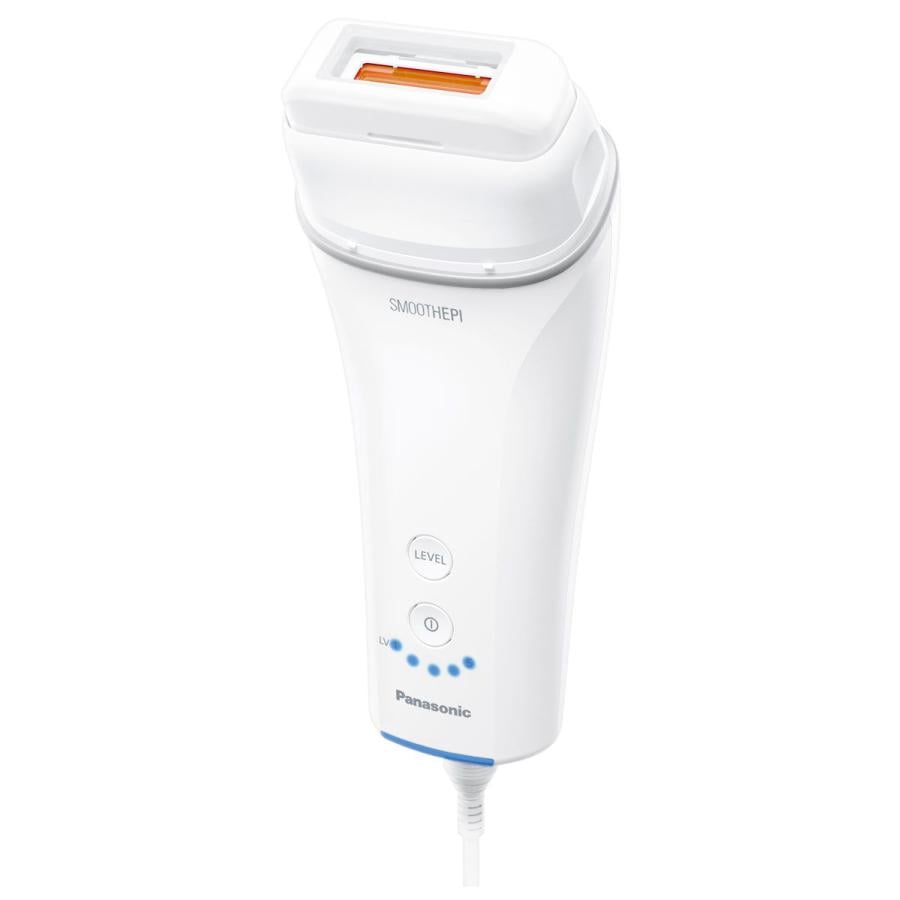
Panasonic SMOOTHEPI ES-WH7A-W — the sensible IPL entry point

Released May 2023, this is Panasonic’s compact SMOOTHEPI, priced at about 33,232 JPY (roughly $210 USD, August 2026) per the listing. It ships with separate attachments for the body, V-zone, I-zone, O-zone (together, the VIO/bikini area), and face, and works on the IPL principle described above — the flash reacts to the dark pigment in hair, and Panasonic’s own copy describes it as designed for gradual improvement with repeated use rather than a one-session fix.
Caveat: because it’s IPL, results build slowly over weeks of consistent sessions rather than instantly, and — as covered above — it’s not going to work well if your hair is very light-colored or your skin tone is very dark, since the flash relies on contrast between the two.
Does IPL actually work for everyone?
Not universally, and this is worth understanding before buying: IPL specifically targets the melanin (pigment) in hair. That means it performs best on dark hair against light-to-medium skin. If your hair is blonde, gray, white, or red, or if you have deep skin tone, the contrast an IPL flash needs to distinguish “hair” from “skin” often isn’t there, and results can be inconsistent or the device may not be recommended for your combination at all per general manufacturer guidance for this device category. If that’s your situation, a Soie epilator (which works purely mechanically, regardless of hair or skin color) is the more reliable pick from this lineup.
Panasonic SMOOTHEPI COMPACT ES-WH7C-W — the pricier “compact” step up

Listed at about 52,355 JPY (roughly $330 USD, August 2026) per the Discovery Japan Mall page — despite the “COMPACT” name, this actually costs more than the standard ES-WH7A-W above, which suggests it’s a newer or more refined unit within the same lineup rather than a stripped-down budget option. It covers the same face/body/VIO territory as the standard SMOOTHEPI.
Caveat: the listing doesn’t include a detailed spec breakdown, so beyond “newer and pricier,” it’s not fully clear from the product data alone what specific feature justifies the jump over the ES-WH7A-W — worth comparing photos/specs on the live listing before choosing this over the standard model.
Panasonic SMOOTHEPI POWER & COOL ES-WG0B-H — the flagship

The most expensive device in this entire roundup by a wide margin, at about 144,654 JPY (roughly $910 USD, August 2026) per the listing. As the name spells out, this is positioned as Panasonic’s highest-power SMOOTHEPI, paired with a built-in cooling function — a common pairing on flagship IPL devices, since higher-intensity flashes generate more heat sensation on skin, and integrated cooling is the standard way manufacturers offset that.
Caveat: this is a serious financial commitment for a device you’re using at home rather than in a licensed clinic, and at this price point it’s worth comparing directly against a handful of in-person laser hair removal sessions before deciding an at-home flagship is the better value for your situation.
How to Actually Use These in a Routine
Whichever mechanism you pick, both benefit from gentle exfoliation a day or two beforehand (it helps prevent ingrown hairs and lets the epilator or IPL flash reach hair more effectively) and skin that’s clean and free of lotion, oil, or deodorant residue at the time of use. Epilating is typically done every 2-4 weeks as regrowth becomes visible; IPL sessions are typically spaced about two weeks apart for the first 2-3 months, then tapered to occasional maintenance sessions once hair thins out. Neither device belongs anywhere near broken skin, sunburn, or a fresh tan, and IPL specifically should never be used near the eyes — most SMOOTHEPI attachments are designed to exclude that area for exactly this reason.
Comparison Table
| Product | Mechanism | Areas Covered | Best For | Approx. Price (Aug 2026) |
|---|---|---|---|---|
| Soie ES-WS35-P | Root-pulling epilator, AC/corded | Legs, arms, underarm, V-line (swappable heads) | Cheapest way to try epilation | 7,291 JPY (~$46) |
| Soie ES-EY4A-W | Root-pulling epilator, rechargeable | Legs, arms, underarm, V-line | Cordless mid-tier upgrade | 18,265 JPY (~$115) |
| Soie ES-EY8A-P | Root-pulling epilator, rechargeable | Legs, arms, underarm, V-line | Top-of-line epilator in this lineup | 25,916 JPY (~$163) |
| SMOOTHEPI ES-WH7A-W | IPL, light-based | Face, body, V/I/O zones | Sensible first IPL device | 33,232 JPY (~$210) |
| SMOOTHEPI COMPACT ES-WH7C-W | IPL, light-based | Face, body, VIO | Newer/higher-tier IPL step-up | 52,355 JPY (~$330) |
| SMOOTHEPI POWER & COOL ES-WG0B-H | IPL, light-based, integrated cooling | Face, body, VIO | Flagship, highest power in lineup | 144,654 JPY (~$910) |
Prices are approximate USD conversions from JPY listings as of August 2026 exchange rates and exclude shipping/customs; check the live listing for the current price before buying.
FAQ
Which lasts longer, an epilator or IPL?
An epilator pulls hair out at the root, so skin stays smooth for roughly 2-4 weeks per session, but hair grows back the same as before. IPL doesn’t remove hair instantly — it damages the follicle with light over repeated sessions, so hair that sheds after a course of treatments tends to grow back finer and sparser over time, though it’s a gradual reduction rather than guaranteed permanent removal.
How do I patch test a new epilator or IPL device?
For an epilator, run it over a small area (like part of one calf) and check for excessive redness, bleeding, or discomfort beyond a normal tweezing sensation before doing a full leg. For IPL, use the lowest intensity setting on a small patch of skin first and wait 24-48 hours to confirm there’s no unusual reaction before treating a larger area, and always use any included protective eyewear if the device calls for it.
Will these work on any hair color or skin tone?
Epilators work purely mechanically, so hair and skin color don’t matter. IPL devices like SMOOTHEPI rely on the flash detecting dark pigment in hair against lighter skin, so they generally don’t work well on blonde, gray, white, or red hair, and manufacturer guidance for this device category typically advises against use on very dark or deeply tanned skin. Check Panasonic’s compatibility guidance for your specific hair/skin combination before buying an IPL device.
How do I verify authenticity, and what about shipping and customs from Japan?
Buying through a listing that’s explicitly sourced from Japan, like Discovery Japan Mall, and checking model numbers and packaging against Panasonic’s official Japan site are reasonable ways to confirm you’re getting a genuine unit. Since these ship internationally from Japan, factor in shipping time and the possibility of customs duties or import fees depending on your country — these aren’t included in the listed JPY price — and expect instruction manuals in Japanese, so it’s worth looking up an English demo video for the specific model before your first use.
Are these safe to use on the face or bikini/VIO area?
Some models (the SMOOTHEPI line here) explicitly include attachments for the face and VIO zone, but always use the specific attachment designed for that area rather than a body head, since sensitive areas need a gentler setting or smaller contact surface. Avoid the eye area entirely with IPL, patch test first on any new area, and if you have a diagnosed skin condition, are pregnant, or have any concerns about a specific area, check with a dermatologist or doctor before using an electronic hair removal device there.
The Takeaway
If hair removal gadgets are your gateway into J-beauty tech, it’s worth also reading our breakdown of ReFa’s microcurrent facial rollers — a completely different category of Japanese beauty device, aimed at facial contour rather than hair.
Panasonic’s Soie and SMOOTHEPI lines solve the same problem — unwanted hair — with genuinely different tools. If you want smooth skin today and don’t mind repeating the process every few weeks, an epilator like the budget ES-WS35-P or the rechargeable ES-EY8A-P is the more predictable, hair-color-agnostic choice. If you’re willing to trade instant results for a device that can make hair progressively finer and sparser over a few months, the SMOOTHEPI IPL line — starting with the ES-WH7A-W — is the better long game, as long as your hair and skin combination is a good match for how IPL actually works. Either way, buy from a Japan-sourced listing, patch test before your first full session, and don’t expect either category to deliver a permanent, one-and-done result.
コメント